
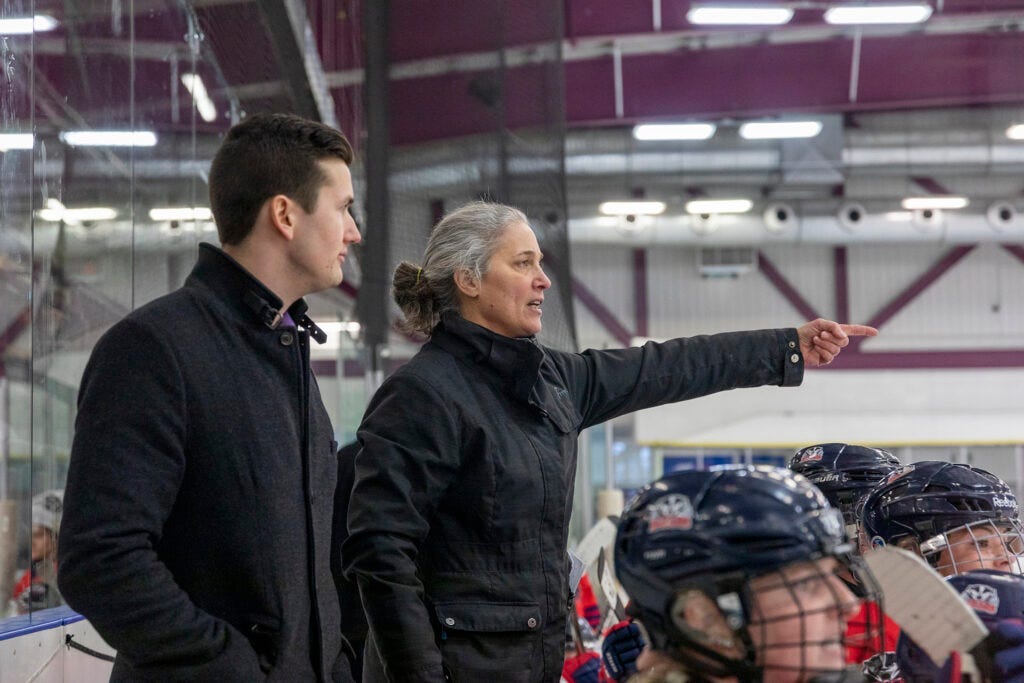
Margot Page enjoyed a playing career that saw her bring home gold medals while playing alongside many of the game’s most recognizable names, and a coaching career that has spanned nearly thirty years. And it’s through those lessons learned during her playing days that have helped provide perspective as she swapped the skates for the coach’s whistle.
Our full conversation is available on YouTube here.
It’s a story that starts as many Canadian hockey players’ stories do: on a frozen lake, in the cold depths of winter, inspired by the passion of a sibling.
“We’d walk down to the lake, clear it off and play,” said Margot. “And it was my brother and myself and my older sister. My brother played the game, and I would follow him into the rinks, and I’d just sit there. I sat and watched and absolutely loved it, and I wanted to play. That was probably when I was seven, eight or nine years old.”
But it was the transition from playing on the outdoor rink to playing in a league that led Margot to encounter her first hurdle. At that time, girls just didn’t play hockey; they weren’t allowed to. So that forced Margot to enrol in gymnastics, track and field, and other sports that, sure, she enjoyed, but it just wasn’t the same as hockey. But that all changed when, at around the age of 11, Margot’s dad, who was a bank manager, came home and informed her that the family was moving, something they’d done many times before.
“I was pretty upset because I had friends and everything like that there,” she said. “But then he told me that he had done some research, and where we were moving to, there are some girls’ hockey teams I could join.” It didn’t take any more convincing at that point for Margot to be on board. This is where she got her first taste of being part of a team with the Tiverton Big Reds.
And as Margot put it, “That was sort of the beginning, and I haven’t stopped since.”
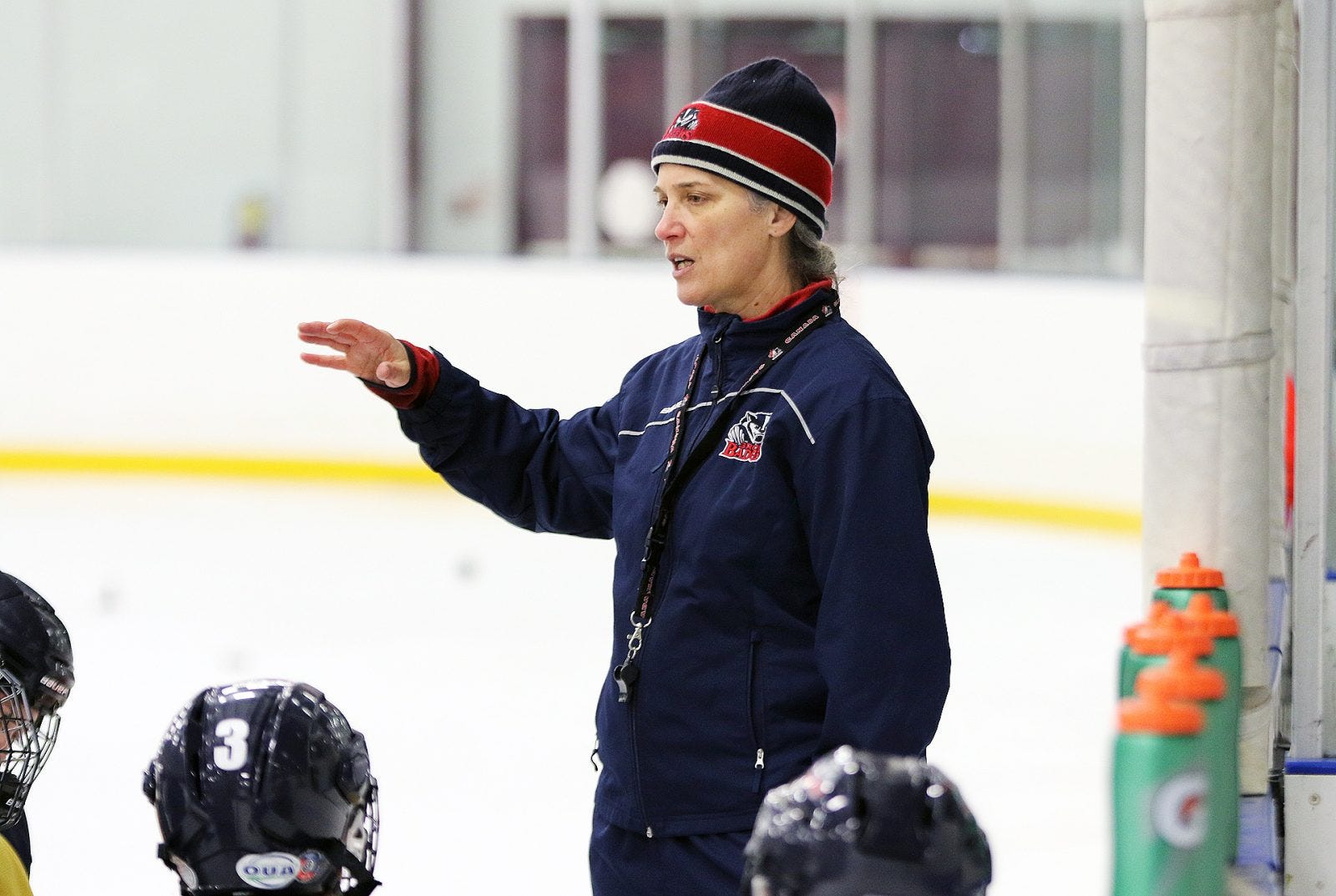
Margot would go on to have a playing career defined by the colour gold. As a member of the Canadian National women’s ice hockey team from 1989 to 1994, Margot would win three gold medals at the IIHF Women’s World Hockey Championships (1990, 1992, 1994). And those experiences, and the lessons learned while playing alongside players like Angela James, Geraldine Heaney and Hayley Wickenheiser, helped provide perspective on what it takes to win, both on and off the ice. One of those was the importance of being humble.
“You might think you’re a great hockey player and then you go in there, and you’re a fourth line player, and you still have to be there for your teammates,” she said. “I get it because I was one of those players, so you can feel for them as to what they’re going through.”
And those valuable insights and discoveries from her playing career, along with a background and passion for teaching, helped Margot make the successful transition from the ice to the bench.
Her first coaching position was with Niagara University's Purple Eagles women’s ice hockey program, where she was named the first coach and would go on to spend 10 seasons. During that time, she also led the National Women’s Under-22 team to gold medals at the 2003 and 2004 Air Canada Cup and 2010 MLP Cup. Margot would also help lead the women’s national team to gold at the 2006 Winter Olympic Games in Torino, Italy, as an assistant coach. Additionally, Margot spent four years with Switzerland’s Under-18 national team, serving as an assistant coach.
Throughout her coaching career, Margot has been uniquely positioned to witness firsthand the growth of women’s hockey, particularly at the USPORTS level.
“That first national team in 1990, we had to pay to try out for our national team,” she said. “So it’s come a long way, which is really neat. And I’m excited to see where it is now.” And with that growth comes the understanding that, to be sustainable in the long term, systems are needed to develop players at all levels.
As it stands, the PWHL is primarily “fed” through the NCAA, with only some exceptions made for the SDHL, and even fewer still through USPORTS. “I would just like to see some sort of link between them,” Margot said, “so that more people who still want to be competitive coming out of the NCAA or USPORTS can still look to develop.”
While that work will be crucial to ensuring the success of professional women’s hockey, Margot knows that the passion is there, the funding opportunities continue to grow, and the sky is the limit for what can be achieved.
From first lacing up her skates on the frozen lakes back home to joining her first team, to being a part of Canada’s gold medal-winning legacy, Margot Page is a name that’s synonymous with women’s hockey, and is a story that has, and will continue to be, an inspiration for so many young girls who will continue to grow the sport.
Our full conversation is available on YouTube here.